
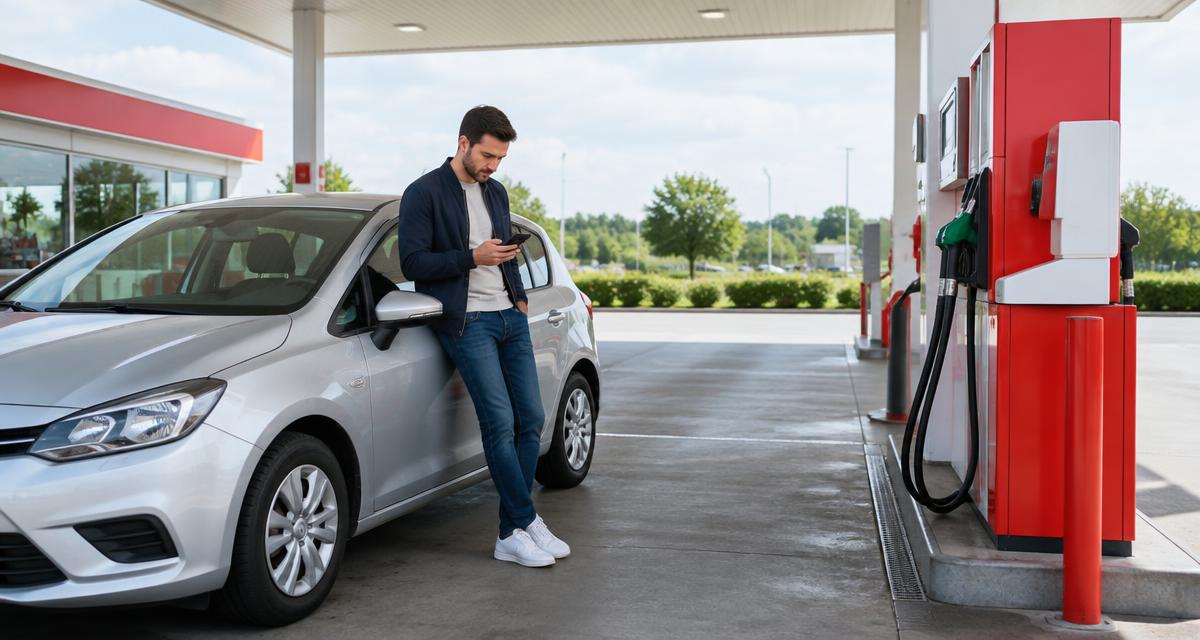
The best way to find cheap gas near you is to compare nearby stations before you leave, match the fuel grade and payment method, and subtract the cost of any extra driving. The lowest advertised number is not always the lowest-cost fill-up. Distance, opening hours, membership requirements, and the age of a price report all matter.
This guide covers road fuel: gasoline, also called petrol, and diesel for vehicles. It does not cover household natural gas or heating tariffs. GasWiser lets you begin with your country, so you compare local currency and fuel units rather than incompatible international prices.
1. Compare stations along your usual route
Start with the area where you already drive: your commute, a shopping route, or a planned road trip. Search from the GasWiser homepage or explore the station map. Look for a small shortlist rather than travelling across town to chase one price.
Compare the same product at each station. A regular gasoline price is not a fair comparison with premium, and petrol and diesel are not interchangeable. Check whether a posted price is per litre, per US gallon, or another local unit. Do not compare countries by the raw price number without converting both currency and volume.
AAA's fuel-price guidance recommends using price-finding tools rather than driving around looking for a bargain. Make your choice while parked, not while using your phone behind the wheel.
2. Check price freshness and discount conditions
A reported price is a useful starting point, not a guaranteed offer. Fuel prices change, and coverage varies by location. Where a timestamp is available, prefer a recent report. Confirm the displayed pump price before dispensing fuel, especially if you have travelled specifically for that station.
- Cash versus card: a sign may show a cash price that does not apply to your card payment.
- Membership: a warehouse or loyalty price may require an account or paid membership.
- Fuel grade: the largest number on a roadside sign may refer only to the lowest grade.
- Opening hours: check that the forecourt is open and accessible when you need it.
- Reward limits: read volume caps, expiry dates, and participating-station conditions.
A reward is only a saving if it applies to a purchase you would otherwise make. Avoid extra shopping just to unlock a fuel discount, and include any membership fee when evaluating long-term value.
3. Calculate whether the detour pays
Use this simple comparison: net saving = price difference × fuel purchased − extra driving cost. Include the entire extra round trip, not just the distance from your location to the cheaper station.
For a hypothetical litre-based example, suppose the cheaper station saves 0.08 currency units per litre and you buy 40 litres. The gross saving is 3.20. If the extra round trip is 12 km and your car uses 7 L/100 km, that detour consumes about 0.84 litres. At 1.60 per litre, it costs about 1.34, leaving roughly 1.86 before allowing for your time and vehicle wear. These are illustrative inputs, not today's local prices.
A gallon-based example works the same way: a 0.10 saving per gallon on 12 gallons saves 1.20 before travel costs. The gas calculator can help estimate a journey's fuel budget. Use your recent real-world consumption where possible, because traffic, load, weather, and road conditions change the result.
4. Build a repeatable fill-up routine
Keep two or three convenient stations in mind and compare them when you need fuel. Pair a fill-up with an existing trip. Do not run your tank dangerously low while waiting for a better price, and do not assume one brand, weekday, or station is always cheapest.
Buying at a lower price and using less fuel are complementary habits. Read our guide to saving fuel while driving, and check whether your car actually needs premium gasoline before paying for a higher grade.
Common questions about finding cheap gas
Is it worth driving farther for cheaper fuel?
Only if the saving on your planned purchase exceeds the extra fuel cost and the value you place on your time. Small purchases and long detours often reduce the benefit.
Are the cheapest stations always the same?
No. Check current local listings and the pump display. A station's price position can change, and payment conditions can make two advertised numbers misleading.
Can I compare petrol and diesel by price alone?
No. Use only the fuel specified for your vehicle. When comparing different vehicles, include their consumption and ownership costs rather than comparing pump prices alone.
Sources and next step
Further reading: AAA: How to Save Money on Gas and AAA: comparing fuel prices and planning costs. Ready to compare? Choose your country and explore stations.